
AI search visibility isn’t the same as traditional SEO rankings, where there is a position your website occupies for a specific query.
Even this traditional concept of organic rankings, at the time of writing, is having its validity and importance questioned by the most skilled and experienced SEOs in light of incredible volatility, which the merging and attempted connectivity of AI and organic search is likely partly responsible for.
So, when it comes to navigating something as new as AI search visibility, how do you assess where you currently “rank”? In this blog, we’ll help you along the way to do just that.
Ranking in AI searches is tricky for a few reasons:
There is no ranking for AI searches
Organisations achieving AI search visibility may be mentioned alongside other brands and within a paragraph of text. This much more conversational response bears little resemblance to traditional search rankings.
AI questions are much longer
AI searches are generally long questions or prompts which can be long passages of text, or multiple questions and answers, depending on how the user talks to the AI model being used.
Tracking AI Search volumes is pretty much impossible
In traditional SEO, with searches typically being between 2 – 5 words, we’re able to measure rankings for those keywords. The longer prompts in AI search make this impossible to monitor. There are just too many variables to determine a single useful metric to measure AI search visibility.
AI Searches rarely give the same results everytime
All AI models, Claude, Gemini, ChatGTP, Perplexity and the LLM are engineered in different ways. So, unlike Google Search, they are not going to give the same results as each other. Additionally, they are unlikely to give the same results if asked the same question twice.
AI searches hallucinate answers and make things up
In traditional SEO, results are pulled directly from webpages, via the mechanism of keywords, and search engines provide the links related to the information in the results so you can check the information.
AI likes to please people, so it has a habit of making things up or hallucinating. The fact that not all content can be trusted makes tracking anything very hard.

How can you check if your website appears in AI Search?
Given all these issues, how on earth can businesses assess their AI search visibility, and determine which content is providing their rankings in searches made across AI models?
Currently there isn’t a unified opinion on that. The traditional tools we use for SEO are trying to keep up, but as with all AI, it moves at such a fast pace that keeping up is really tricky.
Try these AI Prompts to begin assessing your AI search visibility
Here’s a three step question prompt to identify how you rank in AI Search and how to increase your AI search visibility if you’re not initially in the results.
Prompt 1
For the first prompt, pretend that you’re a client searching for your product or service. Remember to tell the model you want it to role play, it makes it more fun, though I’m not sure it adds much else.
Ask your chosen model:
“If you are a {insert your ideal client profile} looking for a {insert service/product} to solve {key issue your ideal clients have} which company would you use?”
If you’re on the list, happy days. You win!
Prompt 2
If you’re pre AI optimisation, and inevitably are not in the list, follow up with this prompt:
“How does {insert your business name} compare to these and why didn’t you include it in the original short list? Be very honest and objective.”
Be aware that the answer to this may be very sycophantic saying that it’s so sorry and that your business should have been included. Ignore that and focus on the points it raises.
Prompt 3
Once you have that answer, finish with his prompt.
“What could {insert your business name} do to its content to be included in your list in the first instance? What are the signals you are looking for which are missing?
Repeat the exact same questions using more AI Models
Repeat the questions on at least three AI tools, I’d suggest ChatGPT, Perplexity and Gemini. Copy all the answers into one document and see where the common issues are.
Then use your own common sense to work out what to do to solve the issues.
Remember that, although the AI is surfacing the information, it’s a human who’s using it and a human who’s your customer. Meaning, your fixes should be carefully considered before you make them. The goal is to serve humans and algorithms, not algorithms alone.
It’s also critical to remember that AI search visibility is not the only goal. Your content isn’t just being ranked by AI models. It’s being indexed and ranked by traditional search engines too, which have remarkably similar but not identical ranking criteria (though these are far from crystal clear). Therefore, it’s critical to create a balance, where you’re optimally optimised for both traditional and AI search engines. Keep this in mind when considering and implementing the responses to Prompt 2.
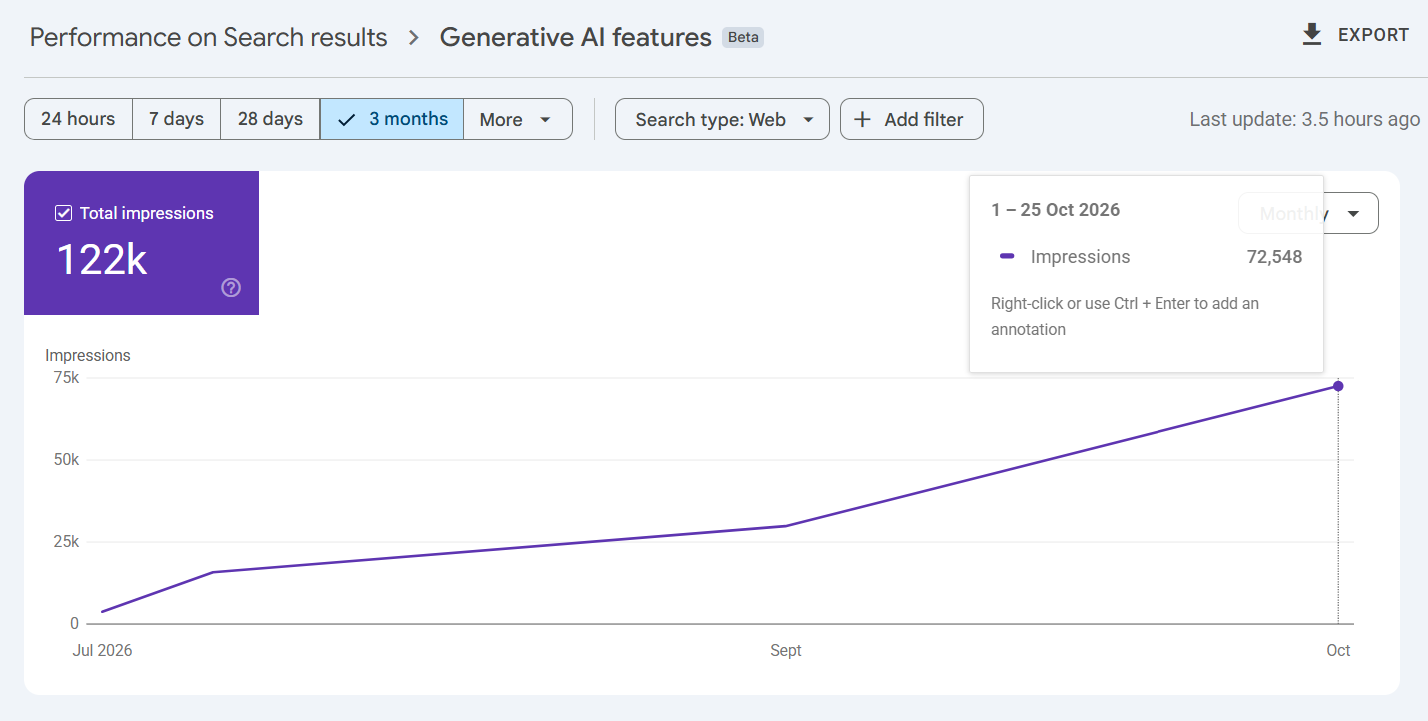
Google Search Console can help you with AI Searches
Google Search Console has a new tab that shows AI search traffic to your website. But it shows the pages that got impressions from AI search – not the query that led to that page.
While this doesn’t give you the detail, by indicating the pages shown, and the volume of impressions, it at least gives you data that shows that your pages are at least being surfaced in AI searches.
We can help support your AI search visibility
We’re already working with clients to help them increase their AI search visibility and rank in traditional search with great success.
If you need some help sorting the good advice from the AI slop, let us know at The Marketing Optimist by filling in our Contact Form.


